Publishing OpinEKO Concept at Wisdom Days Conference 2026 at the University of Jyväskylä
At the University of Jyväskylä – Wisdom Days 2026 Conference, I had the privilege of presenting OpinEKO publicly for the first time, representing the City of Hämeenlinna on a platform dedicated to research, innovation, and systemic thinking.
I want to write this down while it is fresh – not just as a record of what happened, but because I think the experience itself says something meaningful about where integration work, sustainability, and research intersect right now. And why that intersection matters.

Wisdom Days 2026, photo: Katariina Nikkilä
What OpinEKO Is and Why We Built It
OpinEKO is a social circularity model we have been developing at the City of Hämeenlinna’s International Resident Services department. The core idea is simple: two separate problems actually share a solution. Local industries – especially SMEs – face challenges meeting rising sustainability compliance requirements, from sustainability reporting and climate action to legal obligations and supply chain pressures. At the same time, international sustainability-related talents and professionals living in Finland have exactly the kind of expertise those industries need, but face barriers to accessing the Finnish labour market.
OpinEKO creates a structured triangular collaboration between the municipality, local companies, and international talents. Participants go through a 3–4-month blended training programme covering key sustainability areas – and then work directly on real assignments with partner companies. Both sides grow and benefit.
The model is rooted in the UN Sustainable Development Goals – particularly, SDG 8, 10, 11, 12, 13, and 17. This is a practical answer to a real municipal challenge. And we published it as a concept.
Walking Into the Conference Room
Presenting at an academic conference is a different kind of nerve than presenting in a meeting room. Wisdom Days brings together researchers, practitioners, policymakers, and innovators from across Finland and internationally. The theme this year centred on sustainability transformations, which aligned almost perfectly with what we have been building.
The questions that followed the presentation were sharp and generous at the same time. Researchers wanted to understand the measurement logic, how do you track real employment outcomes versus programme completion? How do you isolate the model’s contribution to a company’s sustainability readiness from other factors? These are exactly the right questions, and they pushed my thinking. I left with a clearer sense of where we need to build more rigorous evaluation frameworks as the pilot develops.
OpinEKO was designed with scalability in mind – but those conversations also surfaced the real variables: local labour market dynamics, the strength of existing integration infrastructure, and the willingness of local companies to engage.
The International Dimension: What Those Conversations Opened Up
I spoke with researchers and practitioners from different countries – lots of views, personal notes, and experiences were shared. The potential for cross-country learning here is enormous.
This is the kind of networking that a conference like Wisdom Days makes possible, and why I think showing up to these spaces matters – especially for municipal practitioners who often work in relative isolation from the academic and international research communities.
Sustainability Trends That Are Shaping This Work
One thing the conference made clear is that the compliance environment is accelerating.
That is a structural opening for a model like OpinEKO. The demand for sustainability competence is not going to plateau. If anything, the next three to five years will intensify it. At the same time, the pool of internationally and domestically trained sustainability professionals in Finnish municipalities are growing – people who came here to study environmental management or green technology, finished their degrees, and are now navigating a labour market that does not yet have efficient pathways for them.
The green transition and the integration challenge are converging on the same timeline. That is not a coincidence to manage around – it is a strategic opportunity to use.
“The question is no longer whether international talent belongs in Finland’s green transition. The question is whether we will build the systems that make that contribution possible”
Research Potential: What I Hope Comes Next
Publishing OpinEKO as a concept at an academic conference was a deliberate choice. We want this model to be tested, replicated, and improved.
There are genuine research questions here worth pursuing. How do structured integration-employment pathways affect long-term employment retention compared to traditional job-seeking support? What is the measurable sustainability impact when SMEs receive supervised talent support? How does the circular model affect the professional networks of participants over time?
A Personal Note of Gratitude
None of this exists without the people who made space for it. I want to name them.
Eevaleena Taala co-authored the OpinEKO abstract with me and has been a genuine thought partner throughout the development of this concept. Tanja-Maria Tauro and Niklas Lähteenmäki provided the leadership and guidance that made it possible to bring this idea to the surface.
I am also grateful to the City of Hämeenlinna for being the kind of institution that sends me to a university conference to present this.
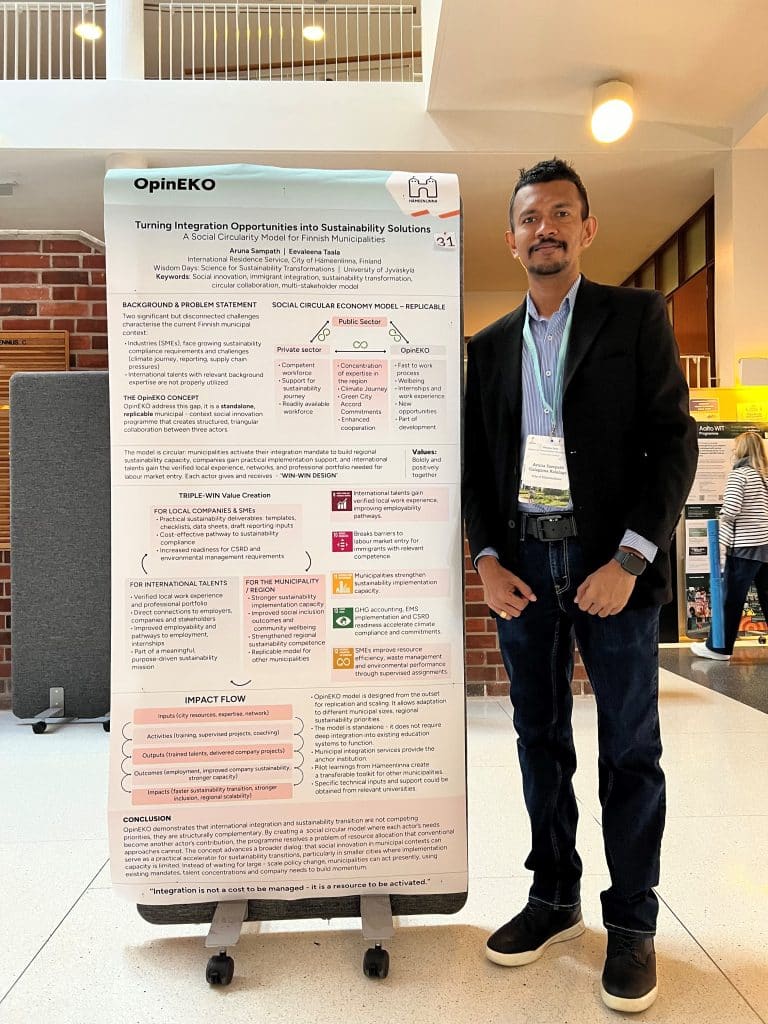
Aruna Sampath and poster about OpinEKO
Aruna Sampath
A sustainability enthusiast, passionate about sustainable development and positive change